The Problem with Simply Leaving Money
Most estate plans answer one question: who gets what when I die? But the families I work with are often asking a deeper question — not just how to pass their wealth to the next generation, but how to pass the wisdom, discipline, and values that built it.
The statistics are sobering. Studies of multigenerational wealth consistently find that the vast majority of family fortunes are depleted by the third generation. The causes are not mysterious: heirs who receive wealth without context rarely understand what it cost to build it, and they have no framework for making it last. An inheritance without education is, at best, a delayed expense.
John H. Nebeker's The Family Bank offers a different model — one that uses the structure of a trust not only to hold and transfer wealth, but to actively teach every generation that touches it how to be a steward of that wealth.
About the Book: The Family Bank by John H. Nebeker presents a framework for using a specially structured trust to function as an internal family lending institution — preserving capital, charging interest that stays within the family, and requiring borrowers to demonstrate financial responsibility before accessing funds. The model is designed to make financial literacy and stewardship a condition of participation, not an afterthought. Learn more at TFBstrategies.com.
What Is the Family Bank?
The core idea is straightforward: rather than distributing inherited wealth as outright gifts that can be spent and are gone, a Family Bank trust holds the wealth and lends it to family members who need capital. The borrower applies for a loan, agrees to repayment terms, and pays interest — at a rate set at or above IRS guidelines — back into the trust. The capital is not consumed; it circulates.
That circulation does several things at once. It keeps the money in the family. It forces the borrower to engage with the money as a steward rather than as a beneficiary. And it gives each generation the experience of borrowing, planning, and repaying — the same financial disciplines that built the wealth in the first place.
The Family Bank is not a bank in the regulatory sense. It is an irrevocable trust with loan provisions drafted into its terms — governed by a trustee (or a family loan committee), documented with promissory notes, and structured so that the IRS treats the transactions as bona fide loans rather than taxable gifts.
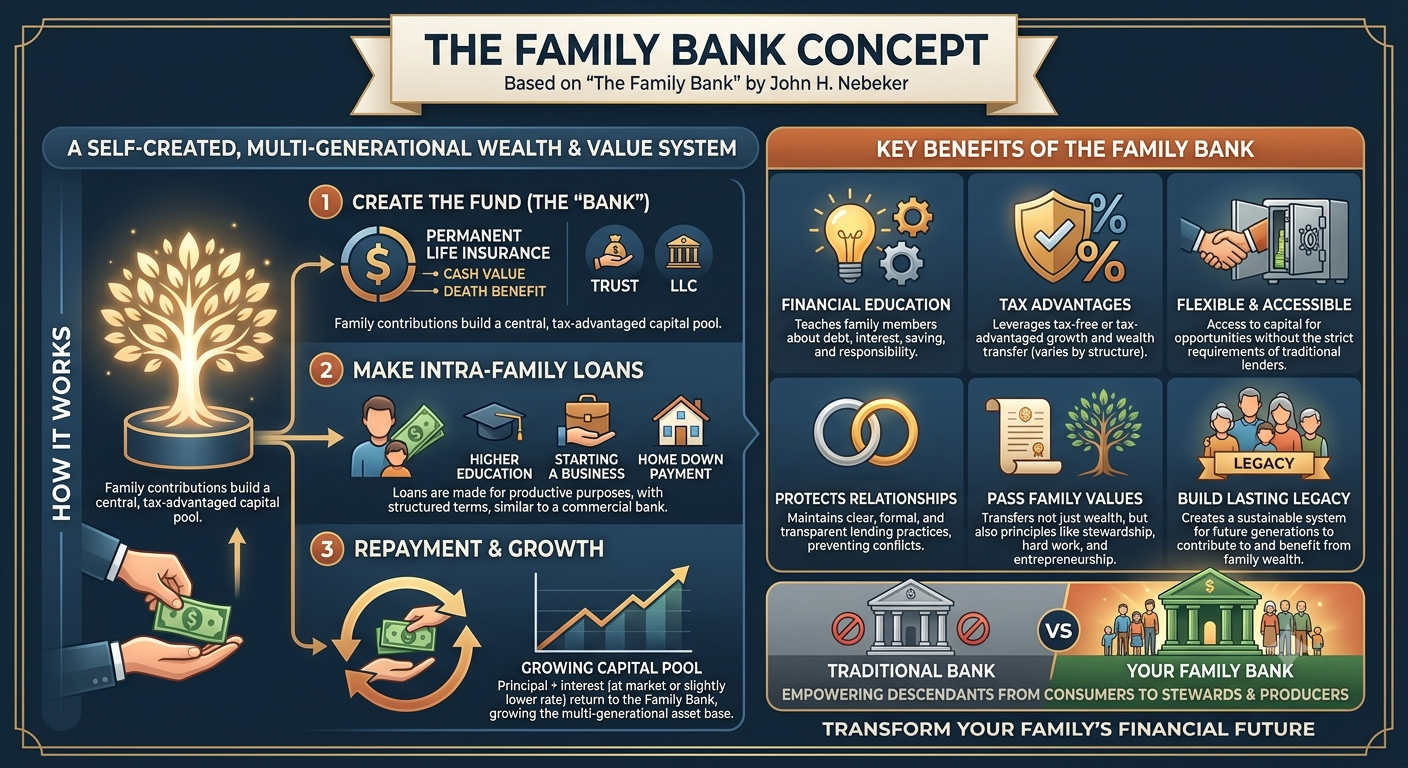
How the Family Bank Works: The Basic Cycle
Funded
The founding generation transfers assets into an irrevocable trust, removing them from the taxable estate.
Borrowed
A family member applies for a loan — for education, a business, a home — and receives funds under documented terms.
Repaid
Principal and interest return to the trust, growing the pool available to the next borrower or the next generation.
What makes the Family Bank different from simply lending money to a relative is the institutional structure around the transaction. A well-designed Family Bank trust includes:
- Written loan policies that specify eligible purposes, maximum amounts, and repayment expectations
- A loan application process that requires the borrower to articulate their plan and demonstrate they have thought it through
- Financial education requirements — borrowers may be required to complete coursework or counseling as a condition of receiving funds
- Promissory notes with an interest rate at or above the IRS Applicable Federal Rate (AFR) to prevent the loan from being recharacterized as a taxable gift
- A trustee or loan committee — either a professional trustee or family members serving in a governance role — who reviews applications and monitors repayment
The Four Principles Behind the Model
Stewardship Over Ownership
Family Bank participants are taught to see themselves as stewards of a shared resource — not owners of an inheritance. The money belongs to the family across time, not to any one person or generation.
Earned Access
Access to the Family Bank is not automatic. A borrower must have a purpose, a plan, and in most designs, a demonstrated baseline of financial literacy before funds are released.
Capital Preservation
Because the funds are loaned rather than given, the principal is preserved. Interest returned to the trust compounds over time, growing the pool available to future generations.
Values Transmission
The loan process itself is a teaching mechanism. Every application, approval, and repayment is an opportunity to reinforce the financial principles the founding generation wants to pass on.
Key Benefits of a Family Bank Trust
- Financial literacy built into the structure. Young family members don't just receive money — they learn to write a loan proposal, justify a purpose, and honor a repayment commitment. These are the building blocks of financial competence.
- Interest stays in the family. When a family member needs capital for a home, a business, or school, they typically borrow from a bank and pay interest to a lender who has no relationship with them. The Family Bank redirects that interest back into the family's own pool of wealth.
- Estate tax efficiency. Assets transferred into an irrevocable trust are generally removed from the grantor's taxable estate. For high-net-worth Utah families watching the federal estate tax exemption, this matters — especially given the uncertainty around future changes to that exemption.
- Asset protection for beneficiaries. Because trust assets are not owned outright by the beneficiaries, they are typically shielded from beneficiary creditors, lawsuits, and divorce proceedings. A child who borrows $50,000 from the Family Bank and builds a business with it does not have that capital sitting exposed in their personal name.
- Multigenerational duration. Utah Code § 75-2-1203 allows a properly structured trust to remain in force for up to 1,000 years. A Family Bank trust built in Utah today can serve grandchildren, great-grandchildren, and beyond without being forced to distribute and dissolve.
- Protection against improvidence. A direct inheritance can be spent in months by someone unprepared to manage wealth. A Family Bank trust keeps the capital intact while still making it available for legitimate needs — ensuring the money is a resource rather than a windfall.
- Family unity and shared identity. Families that operate a shared institution — even a modest one — develop a shared identity around that institution. The Family Bank gives successive generations a reason to stay connected and a framework for how to discuss money as a family.
Who Should Consider a Family Bank Trust?
The Family Bank model is not reserved for the ultra-wealthy, but it does require enough capital to make the lending function meaningful. Families who find it most useful typically share a few characteristics:
- They have built meaningful assets — a business, real estate, investments, or a combination — and want to pass not just the wealth but the discipline that built it
- They are concerned about how outright inheritances will affect their children or grandchildren
- They want the rising generation to earn their access to family capital rather than simply receive it
- They value financial education and want to institutionalize it in a way that outlasts any one person's influence
- They are thinking in decades or generations, not just in terms of what happens after the first death
A note on family governance: The Family Bank works best when the family agrees on the rules before the trust is funded. Who serves on the loan committee? What purposes qualify for a loan? What happens if someone defaults? These are governance questions that belong in a family policy statement — a companion document to the trust that the family can amend by consensus as circumstances change. The trust document itself sets the legal framework; the policy statement sets the family culture.
How to Structure a Family Bank Trust in Utah
Implementing the Family Bank model in Utah involves drafting an irrevocable trust with several specific features that most standard trust documents do not include. The key elements are:
- Loan authority for the trustee. The trust document must explicitly authorize the trustee to make loans to beneficiaries, rather than limiting the trustee to outright distributions. Without this provision, a trustee who makes a loan may be acting outside their authority.
- Interest rate guidance. The document should specify that loans must bear interest at or above the IRS Applicable Federal Rate (AFR) to ensure the transactions are treated as loans — not as taxable gifts under IRC § 7872.
- Promissory note and security requirements. The trust should require a signed promissory note for each loan, and may authorize the trustee to require collateral for larger loans.
- Financial education conditions. The trust can require — or strongly encourage — beneficiaries to complete defined financial education milestones as a condition of loan eligibility.
- Dynasty trust provisions. Utah's 1,000-year vesting rule (Utah Code § 75-2-1203) permits the trust to span multiple generations. The document should be drafted to take advantage of this, with successor trustee and beneficiary class provisions that reach well beyond the current generation.
- Family loan policy statement. Alongside the trust document, the family should adopt a written policy that governs loan applications, eligible purposes, approval procedures, and repayment expectations. This document can be updated by the family without requiring a formal trust amendment.
In practice, the trust document and the family policy statement work together: the trust creates the legal authority, and the policy statement creates the family culture that gives the trust its purpose.
The Legacy That Money Alone Cannot Buy
When Nebeker describes the Family Bank, he is pointing at something that estate planners often overlook: the difference between transferring wealth and transferring the capacity to manage it. An heir who understands compound interest, who has experienced the discipline of repaying a loan, and who sees themselves as a steward of something larger than themselves — that heir is fundamentally more likely to preserve and grow what they receive than one who simply opened an envelope.
The Family Bank is, at its core, an education system funded by the family for the family. It uses the structure of law — the trust — to make financial literacy not optional, not occasional, but structural. Every generation that participates learns by doing. Every loan repaid makes the next loan possible. The money teaches, and the teaching multiplies the money.
That is a legacy worth building.
Frequently Asked Questions
-
A Family Bank trust — a concept developed by John H. Nebeker — is an irrevocable trust structured to function as an internal lending institution for a family. Instead of simply distributing inherited wealth as outright gifts, the trust makes loans to family members who apply, demonstrate a purpose, and agree to repay the funds with interest. The repaid principal and interest return to the trust, where they grow and become available to the next borrower or the next generation.
-
The process varies by trust design, but typically a family member submits a written loan application describing the purpose (education, a business startup, a home purchase, etc.), a repayment plan, and in many cases evidence of completing a required financial education component. A trustee — or a family loan committee — reviews the application, approves or modifies the terms, and issues a promissory note. The borrower repays principal and interest on the agreed schedule, and those funds return to the trust corpus.
-
To avoid the IRS treating a loan as a taxable gift, the interest rate must equal or exceed the Applicable Federal Rate (AFR) published monthly by the IRS. For family loans with terms over nine years, the long-term AFR applies. Charging the AFR keeps the transaction off the gift tax radar while ensuring the interest stays within the family rather than going to a commercial lender.
-
Utah Code § 75-2-1203 allows a trust to remain in force for up to 1,000 years before any vesting requirement applies — making Utah one of the most favorable states in the country for dynasty-style trusts. A properly structured Family Bank trust can serve multiple generations of a family under Utah law, building and preserving wealth for grandchildren, great-grandchildren, and beyond.
-
Yes. Because assets held in an irrevocable trust are generally not owned by the beneficiaries, they are typically protected from a beneficiary's creditors, divorcing spouses, and lawsuits. Utah's asset protection statutes provide additional tools that can be layered into the trust design. A beneficiary who borrows from the Family Bank and repays the loan does not have assets sitting exposed in their own name.